Showing posts sorted by relevance for query chicken broth. Sort by date Show all posts

Wednesday, January 16, 2019

RECIPE: Easy Chicken Broth, Stovetop

I'm making chicken broth/stock today and decided to post my method even though there are hundreds of recipes online.   According to this recipe from The New York Times:
The difference between bone broth and regular broth, or stock, comes down to the length of the cooking time and the addition of acid to the cooking liquid. They taste very similar, though the bone broth has a slightly more intense flavor and a thicker, silkier texture. They can be used interchangeably in recipes. Really, the main difference is that many people consider bone broth to be therapeutic: the longer cooking time of a bone broth allows the collagen and minerals from the bones and connective tissue to dissolve into the liquid.

This website explains that a stock is based on bones, and a broth (bouillon in French) is based on meat.  While a broth can be very flavorful, a stock delivers a rich mouthfeel courtesy of the gelatin that is slowly extracted from the bones.

This webpage lists 10 reasons why you should make your own broth.

Here is an EXCELLENT RESOURCE for all broth related questions, Please do read it!

I've been making bone broth for a looooong time - this is the consolidation of all the recipes and advice I've followed over the years with the important parts highlighted in bold.  I apologize in advance for the length of this post but there was a lot of information I wanted to share.

The tastiest broth is made with the whole chicken, including the meat, but the bones, especially the feet, are the healthy bits so if you don't have meaty parts, don't worry about it.

If you want the stock to have that unctuous gelatinous quality, you must add chicken feet.  The gelatin and collagen in the feet are what create the luscious mouthfeel.

For a darker richer-looking stock, roast the bones first in a 400F oven for about 30 minutes until they're nicely browned.  I have found that this darker stock changes the color of what I add it to which is sometimes a good thing and sometimes not.  Often, I need a lighter stock that will just add flavor and not color, in risotto for instance.

Taste Considerations

My friend and I just compared three different broths: one made with whole chickens, feet, and vegetables, simmered for 3 days and then concentrated; one made with whole chicken, no feet and no vegetables, simmered for 24 hours; and one made with only feet and no vegetables, simmered for 12 hours.  Comparing these enabled us to make informed decisions regarding what was important when making broth:

The one made with all three components and then concentrated was the best tasting and required the least amount of storage space.  The one made with only feet and no vegetables had the best mouthfeel and an acceptable taste.  The one made with only chicken rated the lowest with respect to taste and mouthfeel.

We felt that the best broth would be a combination - long simmered whole chickens and vegetables combined with chicken feet simmered for a shorter period of time.  If you're consuming broth purely for health, the version made with only feet was the fastest, cheapest and healthiest version.


Today I am making a light stock.

Easy Chicken Broth, Stovetop
Makes 1.5 gallons

When I make stock,  I normally use a 12 quart stock pot which yields about 2 gallons of stock.  This pot easily holds two whole chickens and plenty of veggies.  If I'm only using one chicken (2-3 lbs)  or only feet, I will use a 6-quart pot.  If I luck into large amounts of chicken (like when the farm is processing them, or if I find them on sale), I will make an even bigger batch in a 16-quart or 24-quart pot.

In other words, the recipe can be scaled up or down.

Do NOT use an aluminum pot!   The aluminum will leach into the broth.  I use stainless, you can use enamel ( water bath canner would make a perfect stock pot!) or enameled cast iron.  Some people use uncoated cast iron but I worry that the acid will leach too much iron into the stock.

INGREDIENTS

  • 2 small (3 pound) pasture raised chickens or 4 pounds of bones including the feet (animals store heavy metals in their bones, so please use clean chickens!)
  • 10 quarts (2.5 gallons) spring, filtered, or distilled water (you will be concentrating whatever contaminants are in your water)
  • 1 T. mild acid, helps extract minerals and collagen from the bones (I use fresh lemon juice, you can use apple cider vinegar, wine vinegar, or wine; regular vinegar will impart a strong flavor)

OPT - all the ingredients listed below are optional!  They add flavor, but I will often make broth with just bones/meat so that the flavor of the broth doesn't interfere with what I'm using it in.

  • 1 t. himalayan pink salt
  • 6 large scrubbed but unpeeled carrots, cut into chunks
  • 2 large unpeeled onions, cut into chunks*
  • 2 leeks, white and green parts, cut into chunks**
  • 1 bunch celery, including the heart, or 2 medium celeriac, cut into chunks***
  • 3 heads garlic, unpeeled, halved through the center
  • 1 bunch flat leaf parsley
  • 1 small garnet yam or japanese sweet potato cut into chunks
  • 6 allspice or juniper berries
  • 2 bay leaves
  • 6 strips kelp or kombu
  • 1 c. medicinal mushrooms (turkey tail, chaga, reishi, etc...)


Do NOT rinse the chicken!  Do remove the bag of giblets from the cavity, if there is one, and use elsewhere; you won't be using the giblets for the stock.

Put the whole chickens into your stock pot and cover with 2" of water.  If you're using them, do not add the feet or the vegetables yet!  Add acid and salt and let the bones sit in the acidic water for one hour.  NOTE: I've JUST read that if you don't soak the bones in COLD water before turning on the heat, you need to cook them for much longer to extract the minerals!  She claims that, "If the bones are hot, the pores are closed, and the vinegar can’t get in to work its magic."  (This woman recommends 2 T. ACV for every quart of water but I have NEVER used that much and no other recipe I've seen recommends that much so take her advice with a grain of salt.)

After one hour, turn heat to high.  Do not cover!


Cover with clean water
Monitor the pot until the water starts to steam and small bubbles make their way up from the bottom.  DO NOT LET IT BOIL!  When you see small bubbles, turn the heat to low, cover the pot and let it simmer for at least 1 day, preferably 2.  Yes, 2 days.  (Most recipes instruct you to let it cook for at least 4 hours but I find the flavor is richer after a longer infusion.)
After 12 hours on the left (the liquid is simmering, NOT boiling)  After 24 hours on the right (looks and smells good!)

Check periodically to insure the water is not boiling - you want a gentle simmer.  The water should never boil.  Overheating the broth can cause the protein to break down and the broth to become cloudy. If your burner does not have an ultra-low setting and you need to keep the lid ajar to prevent boiling, if the water level drops below the chicken, add more water.

Some recipes advise you to skim but I don't.  Using pastured birds there is very little 'scum' so I just strain very well at the end.

CAUTION: Chicken broth STINKS - and not in a good way - when it first starts cooking!
That's one reason why I make bigger batches: I don't have to smell it as often. 
Once the chicken is cooked, about 2 hours in, it will smell better.


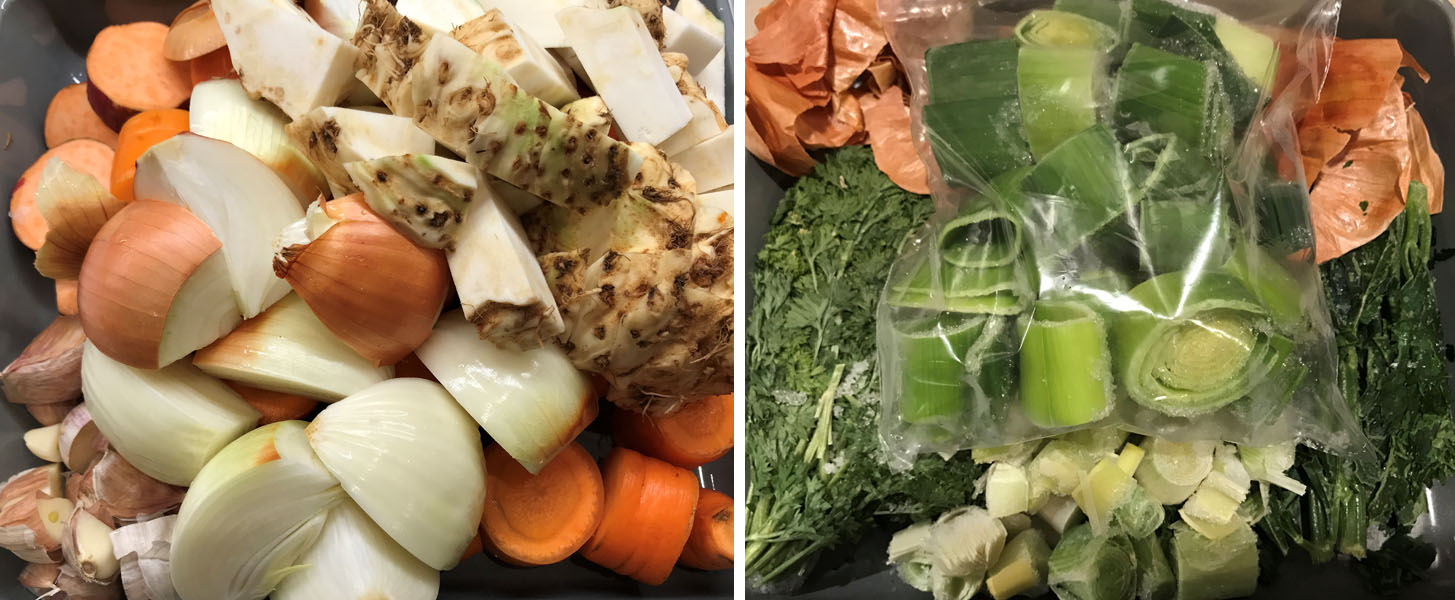
Fresh veggies on the left, frozen veggies on the right.
All veggies in the pot - almost overflowing!  I should have used a 16 quart pot.
After at least 24 hours, add the vegetables and the chicken feet and enough water to insure they're covered.  Some people add vegetables willy-nilly but if you add too much of any one thing, the flavor will be unbalanced.

The reason you add these AFTER the bones have finished cooking is that (1) the vegetables can become bitter if they're cooked too long, and (2) the gelatin in the feet will break down if it's cooked too long.

Bring back to a simmer, cover, and leave overnight or up to 24 hours.  After you add the vegetables. it will smell delicious!

As you can see, my pot was way too full!  So, I left the cover off overnight, and the entire next day.  At the end of that 24 hour period the water level had dropped considerably and the stock was very concentrated.  Since I always reduce my stock anyway, I was fine with this. 

You can see some of the chicken feet in the photo below.


After 3 days, without adding water 

Turn off the heat.  Place a colander over a large bowl.  Using tongs, remove as many of the chicken bones as possible, placing them in the colander.  They will have disintegrated so don't worry if you don't get them all.  Discard the bones.  (These bones are now soft enough that you can give them to your dog, if you're inclined to do so.)  If you cooked your stock longer than 24 hours, don't try and salvage the meat - it's given everything it had to the broth. 

If you cook your broth for 24 hours, and you've been careful not to let it boil, you can use the meat to make chicken salad or some other preparation with added moisture.

Colander over a large bowl on left, large nutmilk bag over colander on right

Using a large skimmer or ladle remove as many of the vegetables as possible, placing them in the colander.  Ladle over as much broth as will fit in the bowl underneath.  Let the vegetables drain and then discard them. (Some people put these in their compost pile but they're covered with chicken fat so I don't.)

Place another colander or strainer over a second large bowl and place a large nut-milk bag, a piece of muslin, or 2 pieces of cheesecloth over the colander.  Slowly pour or ladle the remaining vegetables and broth over the cheesecloth/muslin/nut-milk bag.  If your bowl gets full, transfer it to another bowl or a clean stockpot and continue.  (NOTE: if you're making a small batch and you're tempted to put the bones in the nut-milk bag - don't!  The sharp edges will tear the bag.)

All veggies out of broth on left, strained broth on right (gorgeous color!)

Once you've emptied your stock pot, pour the broth collected in the first bowl through the nut-milk bag/muslin/cheesecloth.  Gather up the ends and encourage the last of the broth to pass through.   You will have difficulty with this since all the tiny holes will now be clogged with sediment.  You don't want this sediment in your broth, so don't force the liquid through.

If you wait too long to strain the stock, and the fat starts to congeal, it will be impossible to strain!  You must strain it while it's hot!
 
You should now have at least 8 quarts of clean broth! (Because I removed the cover for the last 24 hours, I ended up with 5 quarts.)

There are several things you can do with it at this point:

1. Transfer it to glass jars and either freeze or pressure can it.

2. Remove the fat and then proceed with option 1.  To remove the fat you will need to let the stock cool in the fridge overnight and then scrape off the fat, which will have risen to the top and solidified.  Save the fat and use it to fry potatoes.

3. Reduce the volume, which will intensify the flavor and require less room to store.  When you use it, you can reconstitute it, if necessary, or use it as is.

I generally go with option 3 as follows:

Transfer all the broth to a clean stock pot, bring to a simmer and, leaving the lid OFF, let the liquid reduce by half.  You can now proceed with option 1 or 2 above, or you can reduce it further and make your own demiglace or 'bouillon cubes'.  If you're going to make demiglace, you must first remove the fat.
Removing fat from reduced stock on left,  defatted stock on right
(it's easier to remove the fat from a tall narrow container, than a wide bowl....)

For demiglace, transfer the de-fatted broth to a smaller pot, bring to a simmer and, leaving the lid OFF, let the liquid reduce by half again.  Transfer to a smaller pot and let it reduce by half a third time.  You should now have 8 cups of a very concentrated chicken broth - demiglace.

At this point, you can transfer the demiglace to ice cube trays and freeze - each cube will reconstitute to approximately 1 cup of broth - or you can pressure can it.

I pressure can it in 1/2 c jars.

Two layers of jars in my canner: pint jars on bottom, 1/2 cup jars on top

To reconstitute:  1 demiglace cube, or 1 tablespoon, in a mug with hot water and salt to taste.  

* Whenever I peel an onion, I save the outer layers (which are rich in quercetin) and the root end in a bag in the freezer.
** Whenever I use leeks, I save the dark green leaves in a bag in the freezer.  In summer, when they're abundant, I will also cut up whole leeks and store them in the freezer.
*** Whenever I use celery, I save the outer stalks and the leaves in the freezer.
During the summer, I freeze bags of clean parsley to use in stock.

Using the above mentioned * tricks, I always have vegetables prepped and ready to use in the freezer whenever I decide to make stock.

A Note on Pressure Cooking Stock

Using a pressure cooker will greatly reduce the amount of time it takes to make stock.  HOWEVER, a study done by a SeriouseEats contributor rated the stovetop stock better than either pressure cooker or slow cooker:
"It’s been pretty consistent with every test I’ve done on this in the past: pressure cooker will get you to good results *faster*, but not necessarily absolutely better results. To my palate, the broths did taste slightly different: the pressure cooker version was a little sweeter, maybe due to more maillard reactions taking place in the higher heat, but I don’t necessarily think that’s a good or a bad thing, it’s just different."
If you're interested in this method, you should read the comments because they are enlightening.  One commenter recommended cutting everything as small as possible, including the bones, to get better extraction.   Another commenter referenced a study that claimed a modern pressure cooker made better broth than a jiggle-top pressure cooker.  A third claims that only a pressure cooker can extract gelatin from BEEF bones, but it doesn't do much better than stovetop for chicken.

The main reason why I don't use a pressure cooker is that I haven't found a stainless one that's big enough.  I prefer to make a large amount of broth, concentrate it, and then pressure can it.   I will be researching pressure cooked beef bone broth, though, to see whether it improves gelatin extraction.


Sunday, April 19, 2020

RECIPE: COVID Chicken Broth with Leeks, Carrots, Onions, Garlic

I'm calling this "COVID-19 Broth" because I developed it to help us resist the disease.

Several of the practitioners I follow recommended collagen-rich broth, as well as alliums (onions, leeks, scallions), carrots and garlic, to boost your immune defenses.  I needed to make more broth anyway, but I was all out of chicken feet, which are rich in collagen, so I adjusted my recipe slightly:  I increased the amounts of the above mentioned vegetables, and added collagen powder.  If you have trouble sourcing feet, this is one way to overcome that.

I made a large batch, so we could have some every day.  You can scale down if necessary.


Please read the detailed directions in this post first, before proceeding with this recipe.


COVID-19 Chicken Broth with Extra Collagen

Makes 12 quarts

3 whole chickens, with feet if possible
1 T. apple cider vinegar
1 T. himalayan pink salt
4 leeks, cleaned and chopped into 1" pieces
10 carrots, scrubbed and chopped into 1" pieces
4 heads of garlic, halved
2 cups chopped onions and/or onion skins (I used the skins, I keep a bag in the freezer)
1 bulb of celeriac, scrubbed, or 4 stalks of celery, cut into 1" pieces
1 small bunch parsley
4-5 bay leaves
1 t. allspice or juniper berries
12 scoops collagen powder from pasture raised animals

Preheat the oven to 400F.

Place the chickens in a deep roasting pan and roast until they're nicely browned, 30-45 minutes.


Fill a large stockpot with 12 quarts water (my pot holds 16 quarts) and add the vinegar and salt.

Transfer the chickens and any juices into the stock pot filled with water (BE CAREFUL - I didn't realize their cavities were full of fat, and I made a HUGE mess on my cooktop!!).

Fat everywhere!!

Turn heat on low, and bring slowly to a gentle simmer.  Adjust the heat to maintain a gentle simmer - small bubbles rising up through the water - DO NOT LET IT BOIL!!  If it boils, your stock will be cloudy.  Cook, with the cover on, for 24 hours.

Chicken in 12 qts water before and after 24 hours.


Add the vegetables, herbs and spices and cook for 12-24 hours.

Veggies in broth before and after 24 hours.


Strain the broth and discard the meat and veggies.  I used a large cheesemaking bag set over a colander, set over an 8-quart bowl.  I removed the solids first, using a skimmer, and discarded them.

Even without the solids, the pot was too heavy for me to tip the broth into the strainer so I used a 1-quart saucepan as a ladle! 

Removing the solids, then straining the broth.


Isn't this the most beautiful chicken broth you've ever seen?!  I couldn't believe how rich it looked and tasted!

Can you believe this is CHICKEN broth?!


My pressure canner will only hold 7 quart jars so I transferred 7 quarts of broth into an 8-quart stock pot to reduce its volume.  I set this stock pot over medium heat, to maintain a gentle boil, and let it cook with the lid off until reduced by half, about 2 hours. 


Here comes the hard part...adding the collagen powder.  

I used this recipe by Fearless Eating as a guide:  Adding collagen powder to broth

If you add the collagen powder to hot liquid it will clump.  DON'T DO IT!  When I tried it (yes, I had to see for myself) it seized up immediately and I was unable to break up the big clumps!


Fearless Eating recommends adding it to cold water, but I didn't want to dilute my beautiful broth so I transferred 6 cups of broth to a baking dish to cool.  You can see it in the 'beautiful' photo further up.

When the broth reached room temperature, I added one scoop at a time using a fine mesh strainer and whisking in-between.  It still clumped a bit towards the end, but those small clumps dissolved when I added it to the warm stock.  I used half the amount called for in the Fearless Eating recipe because I didn't want it aspic hard, just pleasantly viscous.  After adding 12 scoops I knew I couldn't add any more so I set it aside to gel.


Adding collagen to cool broth, starting to gel, solid after a few minutes!


By the time I had managed to get all the collagen into the cooled broth, the remaining broth wasn't warm enough to melt the now-solid collagen-broth so I turned my attention to the stock reducing on the cooktop.

When it had reduced by half, I stirred in half the collagen-broth.  After it melted, I transferred 3 quarts into quart jars, and put the remaining quart into two pint jars for immediate use.

I then transferred the remaining 4 quarts of stock into the same pot, heated it to just under boiling, and stirred in the remaining collagen-broth.  I transferred this into 5 quart jars which gave me 4 quarts for my pressure canner, and 1 quart for immediate use.

In the photo below are the 4 quarts of full strength stock on the left, and 1 quart of the double-strength stock on the right.  It's so rich it looks like beef stock, doesn't it!  I also couldn't tell the difference between the full strength and the double strength so I labelled them before I processed them.

Chicken broth ready for the pressure canner.

NOTE: I left 2" headspace because I didn't want to risk loosing any of this delicious nectar, which is why, if you were counting, I ended up with 4 quart jars of double strength stock and 5 quart jars of single strength which adds up to more than the original 12 quarts of liquid - each jar held less than a full quart.


On the left is a photo of the cooled double broth.  I add 2 T to a small mug, add a bit of Himalayan pink salt and fill it with hot water.  Imagine how stiff the broth would be if I had used double the amount of collagen!  (The cloudy stuff on the top is fat.  There would be more if I hadn't spilled it all over my cooktop!)


Thursday, February 7, 2019

RECIPE: Easy Veal (or beef) Bone Broth, Stovetop

A few days ago I posted my recipe for chicken bone broth; but, I must admit, I make and use veal bone broth much more than chicken.  I'm posting my method even though there are hundreds of recipes online.   According to this recipe from The New York Times:
The difference between bone broth and regular broth, or stock, comes down to the length of the cooking time and the addition of acid to the cooking liquid. They taste very similar, though the bone broth has a slightly more intense flavor and a thicker, silkier texture. They can be used interchangeably in recipes. Really, the main difference is that many people consider bone broth to be therapeutic: the longer cooking time of a bone broth allows the collagen and minerals from the bones and connective tissue to dissolve into the liquid.

This website explains that a stock is based on bones, and a broth (bouillon in French) is based on meat.  While a broth can be very flavorful, a stock delivers a rich mouthfeel courtesy of the gelatin that is slowly extracted from the bones.

This webpage lists 10 reasons why you should make your own broth.

Here is an EXCELLENT RESOURCE for all broth related questions, Please do read it!

I've been making bone broth for a looooong time - this is the consolidation of all the recipes and advice I've followed over the years with the important parts highlighted in bold.  I apologize in advance for the length of this post but there was a lot of information I wanted to share.

The tastiest broth is made with meaty bones, but the bones are the healthy bits so if you don't have meaty parts, don't worry about it (or throw in a couple pounds of stew meat).  Marrow bones are very healthy, if you can get them.

If you want the stock to have that unctuous gelatinous quality, you need knuckle bones.  The gelatin and collagen in the joints are what create the luscious mouthfeel.  You also mustn't cook it too long, or the gelatin will break down.

For a darker richer-looking stock, roast the bones first in a 400F oven for about 30 minutes until they're nicely browned.  I have found that this darker stock changes the color of what I add it to which is sometimes a good thing and sometimes not.  Often, I need a lighter stock that will just add flavor and not color, in risotto for instance.

Today I am making a light stock.

Easy Veal (or beef) Bone Broth, Stovetop
Makes 1.5 gallons

When I make stock,  I normally use a 12 quart stock pot which yields about 2 gallons of stock.  This pot easily holds 6 pounds of bones and plenty of veggies.  If I luck into large quantities of bone and don't have room to freeze them, I will make an even bigger batch in a 16-quart or 24-quart pot.

In other words, the recipe can be scaled up or down.

Do NOT use an aluminum pot!   The aluminum will leach into the broth.  I use stainless, you can use enamel (an enamel water bath canner would make a perfect stock pot!) or enameled cast iron.  Some people use uncoated cast iron but I worry that the acid will leach too much iron into the stock.

INGREDIENTS
  • 4-6 pounds of bones including knuckles and marrow (animals store heavy metals in their bones, so please use clean bones!)
  • OPT: 2 pounds of stew meat (if your bones don't have much meat on them)
  • 10 quarts (2.5 gallons) spring, filtered, or distilled water (you will be concentrating whatever contaminants are in your water, and heating aggregates fluoride and metals)
  • 2 T. mild acid, helps extract minerals and collagen from the bones (I use fresh lemon juice, you can use apple cider vinegar, wine vinegar, or wine; regular vinegar will impart a strong flavor)

OPT - all the ingredients listed below are optional!  They add flavor, but I will often make broth with just bones/meat so that the flavor of the broth doesn't interfere with what I'm using it in.
  • 1 t. himalayan pink salt
  • 6 large scrubbed but unpeeled carrots, cut into chunks
  • 2 large unpeeled onions, cut into chunks*
  • 2 leeks, white and green parts, cut into chunks**
  • 1 bunch celery, including the heart, or 2 medium celeriac, cut into chunks***
  • 3 heads garlic, unpeeled, halved through the center
  • 1 bunch flat leaf parsley
  • 1 small garnet yam or japanese sweet potato cut into chunks
  • 6 allspice or juniper berries
  • 2 bay leaves
  • 6 strips kelp or kombu
  • 1 c. medicinal mushrooms (turkey tail, chaga, reishi, etc...)

Put the the bones (and optional meat) into your stock pot and cover with 2" of water.  If you're using them, do not add the vegetables yet!  Add acid and let the bones sit in the acidic water for one hour.  NOTE: I've JUST read that if you don't soak the bones in COLD water before turning on the heat, you need to cook them much longer to extract the mineralt!  She claims that, "If the bones are hot, the pores are closed, and the vinegar can’t get in to work its magic."  (This woman recommends 2 T. ACV for every quart of water but I have NEVER used that much, and no other recipe I've seen recommends that much, so take her advice with a grain of salt.)

After one hour, turn heat to high.  Do not cover!

Monitor the pot until the water starts to steam and small bubbles make their way up from the bottom.  DO NOT LET IT BOIL!  When you see small bubbles, turn the heat to low, cover the pot and let it simmer for at least 1 day, preferably 2.  Yes, 2 days.  (Most recipes instruct you to let it cook for at least 4 hours but I find the flavor is richer after a longer infusion.)

Check periodically to insure the water is not boiling - you want a gentle simmer.  The water should never boilOverheating the broth can cause the protein to break down and the broth to become cloudy.  If your burner does not have an ultra-low setting and you need to keep the lid ajar to prevent boiling, if the water level drops below the bones, add more water.

Some recipes advise you to skim but I don't.  Using bones from pastured animals there is very little 'scum' so I just strain very well at the end.

After at least 24 hours, add the vegetables and enough water to insure they're covered.  Some people add vegetables willy-nilly but if you add too much of any one thing, the flavor will be unbalanced.

The reason you add these AFTER the bones have finished cooking is that the vegetables can become bitter if they're cooked too long.  If you're only going to cook the bones for 24 hours, you can add the veggies at the beginning, but I usually cook my bones for much longer - sometimes 72 hours - so I add the veggies later.

Bring back to a simmer, cover, and leave overnight or up to 24 hours.

Veggies added after bones have released their goodness.
You can see that it's not boiling, only simmering.

Turn off the heat.  Place a colander over a large bowl.  Using tongs, remove as many of the bones as possible, placing them in the colander.  They will have disintegrated so don't worry if you don't get them all.  Discard the bones.  Don't try and salvage the meat - it's given everything it had to the broth.  (Our dog won't even eat it!)


Colander over a large bowl on left, large nutmilk bag over colander on right

Using a large skimmer or ladle remove as many of the vegetables as possible, placing them in the colander.  Ladle over as much broth as will fit in the bowl underneath.  Let the vegetables drain and then discard them. (Some people put these in their compost pile but they're covered with fat so I don't.)

Place another colander or strainer over a second large bowl and place a large nut-milk bag, a piece of muslin, or 2 pieces of cheesecloth over the colander.  Slowly pour or ladle the remaining vegetables and broth over the cheesecloth/muslin/nut-milk bag.  If your bowl gets full, transfer it to another bowl or a clean stockpot and continue.  (NOTE: if you're making a small batch and you're tempted to put the bones in the nut-milk bag - don't!  The sharp edges will tear the bag.)

All veggies out of broth on left, strained broth on right (gorgeous color!)

Once you've emptied your stock pot, pour the broth collected in the first bowl through the nut-milk bag/muslin/cheesecloth.  Gather up the ends and encourage the last of the broth to pass through.   You will have difficulty with this since all the tiny holes will now be clogged with sediment.  You don't want this sediment in your broth, so don't force the liquid through.

If you wait too long to strain the stock, and the fat starts to congeal, it will be impossible to strain!  You must strain it while it's hot!

You should now have at least 8 quarts of clean broth!

There are several things you can do with it at this point:

1. Transfer it to glass jars and either freeze or pressure can it.

2. Remove the fat and then proceed with option 1.  To remove the fat you will need to let the stock cool in the fridge overnight and then scrape off the fat, which will have risen to the top and solidified.  Save the fat and use it to fry potatoes.

3. Reduce the volume, which will intensify the flavor and require less room to store.  When you use it, you can reconstitute it, if necessary, or use it as is.

I generally go with option 3 as follows:

Transfer all the broth to a clean stock pot, bring to a simmer and, leaving the lid OFF, let the liquid reduce by half.  You can now proceed with option 1 or 2 above, or you can reduce it further and make your own demiglace or 'bouillon cubes'.  If you're going to make demiglace, you must first remove the fat.

Removing fat from reduced stock on left,  defatted stock on right
(it's easier to remove the fat from a tall narrow container, than a wide bowl....)

For demiglace, transfer the de-fatted broth to a smaller pot, bring to a simmer and, leaving the lid OFF, let the liquid reduce by half again.  Transfer to a smaller pot and let it reduce by half a third time.  You should now have 8 cups of a very concentrated chicken broth - demiglace.

At this point, you can transfer the demiglace to ice cube trays and freeze - each cube will reconstitute to approximately 1 cup of broth - or you can pressure can it.

I pressure can the first reduction in pint jars, and the demiglace in 1/2 c jars.

Two layers of jars in my pressure canner
pints on the bottom, 1/2 cup on the top

To reconstitute:  1 demiglace cube, or 1 tablespoon, in a mug with hot water and salt to taste.

* Whenever I peel an onion, I save the outer layers (which are rich in quercetin) and the root end in a bag in the freezer.
** Whenever I use leeks, I save the dark green leaves in a bag in the freezer.  In summer, when they're abundant, I will also cut up whole leeks and store them in the freezer.
*** Whenever I use celery, I save the outer stalks and the leaves in the freezer.
During the summer, I freeze bags of clean parsley to use in stock.

Fresh veggies on the left, frozen veggies on the right.

Using the above mentioned * tricks, I always have vegetables prepped and ready to use in the freezer whenever I decide to make stock.

A Note on Pressure Cooking Stock

Using a pressure cooker will greatly reduce the amount of time it takes to make stock.  HOWEVER, a study done by a SeriouseEats contributor rated the stovetop stock better than either pressure cooker or slow cooker:
"It’s been pretty consistent with every test I’ve done on this in the past: pressure cooker will get you to good results *faster*, but not necessarily absolutely better results. To my palate, the broths did taste slightly different: the pressure cooker version was a little sweeter, maybe due to more maillard reactions taking place in the higher heat, but I don’t necessarily think that’s a good or a bad thing, it’s just different."
If you're interested in this method, you should read the comments because they are enlightening.  One commenter recommended cutting everything as small as possible, including the bones, to get better extraction.   Another commenter referenced a study that claimed a modern pressure cooker made better broth than a jiggle-top pressure cooker.  A third claims that only a pressure cooker can extract gelatin from BEEF bones, but it doesn't do much better than stovetop for chicken.

The main reason why I don't use a pressure cooker is that I haven't found a stainless one that's big enough.  I prefer to make a large amount of broth, concentrate it, and then pressure can it.   I will be researching pressure cooked beef bone broth, though, to see whether it improves gelatin extraction.


Wednesday, April 5, 2023

RECIPE: Chicken Breast with Cheese and Poblano in Manchego Crema

This recipe was developed by Cacique, a company that sells some of the ingredients.  Cacique isn't sold where we live so I made substitutions.  I also decided not to roll the breasts - I layered them in the baking dish with the cheese and chiles in between.  It worked, but it was hard to serve, so next time I may slice the breasts into small pieces.  

The flavor was phenomenal - we both loved it!

Original recipe: Chicken Roulade in Mexican Crema

Chicken Breasts with Cheese and Poblano in Manchego Crema

Serves 4-5

INGREDIENTS

  • 2 pounds boneless skinless chicken breasts 
  • 2 T. EVOO
  • 2 T. fresh lemon juice
  • 4 T. fresh cilantro chopped, divided
  • 2 T. ground cumin
  • 2 t. cayenne pepper
  • 2 cloves garlic, minced 
  • 2 t. himalayan pink salt
  • 10 oz melting cheese (I used mozarella) cut into 1/4" slices
  • 3 large poblano chiles, roasted, peeled, seeded* and cut into 1/4" strips
  • 1 cup sour cream
  • 1 cup chicken stock
  • 2 t. Dijon mustard (original recipe called for 1T, but I thought it overwhelmed the sauce)
  • 1 c. shredded Manchego cheese
  • Salt and pepper to taste 

INSTRUCTIONS

Preheat oven to 400F.

Pound the chicken breasts to 1/2" thick.  I had to cut the large pieces in half horizontally to do this.

Mix the chicken breasts with the olive oil, lemon juice, salt, 2 T. cilantro, cumin, cayenne and garlic.  Let the chicken marinate for 30 minutes.  Doesn't that look delicious?  The chicken is good even without the cheese, chiles and sauce!

Marinate the chicken for 30 minutes.

In a small shallow baking dish, lay half the chicken on the bottom, cover with the melting cheese and half of the poblanos, then layer the remaining breasts on top. My baking dish was 6" x 9"

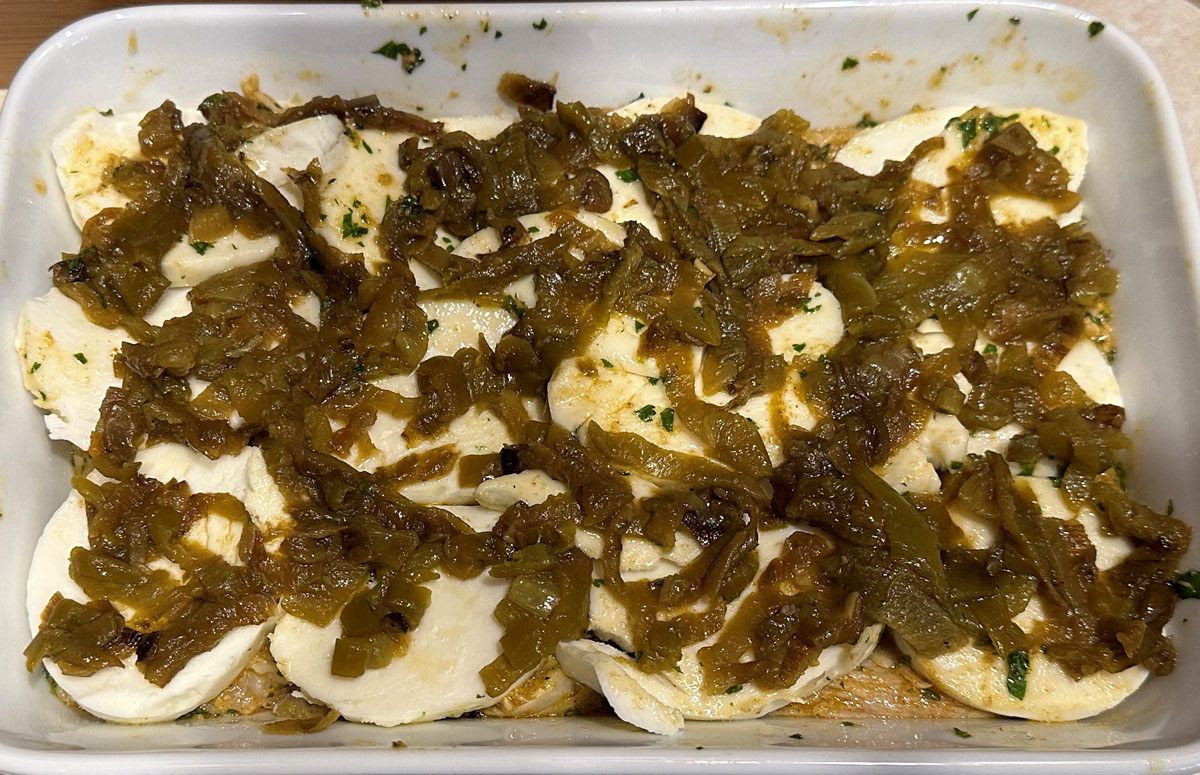
Chicken, then cheese, then poblanos.

Chicken on the bottom, then cheese, then poblano, then chicken on the top.

Bake uncovered for 30 minutes until the chicken is cooked through.

While the chicken is cooking, puree the remaining poblanos and cilantro in a blender or food processor with the chicken broth and the Dijon mustard.  Bring to a simmer over low heat and stir in the sour cream.  Cook for 3 minutes.  Remove from heat and add the shredded Manchego.  Stir until melted.  Season to taste with salt and pepper.

Cover to keep warm until the chicken is ready.  Serve immediately over the chicken.

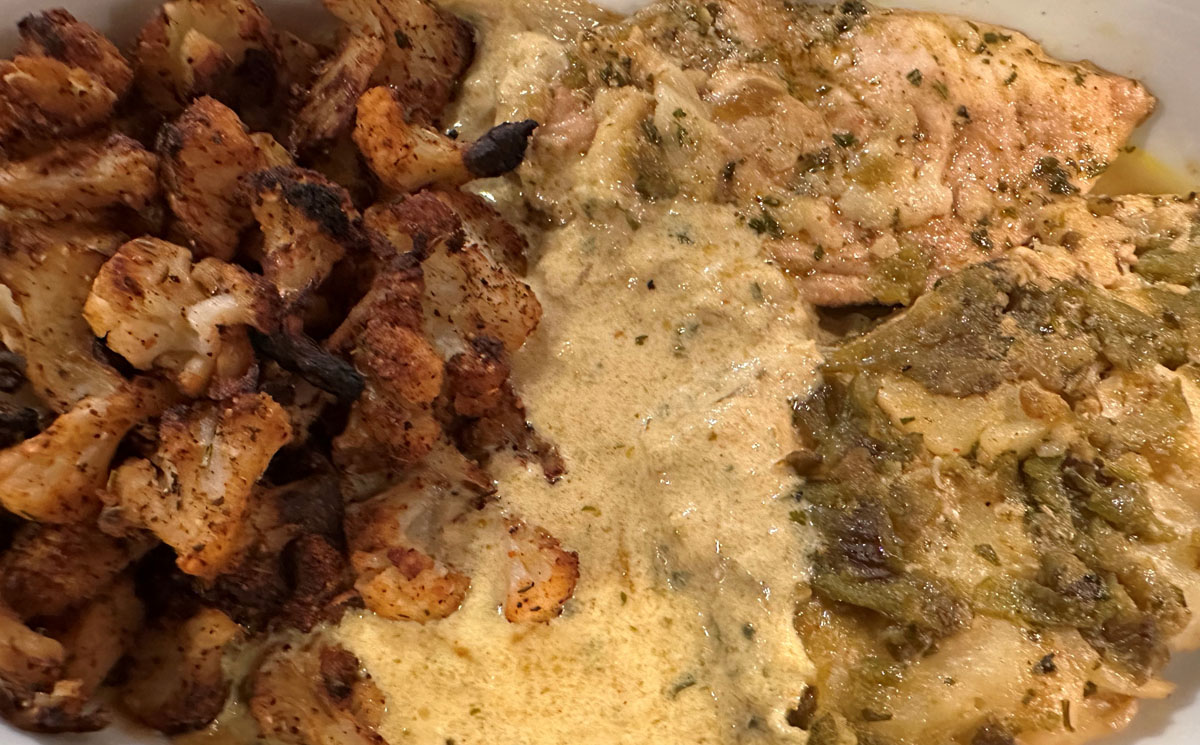
I served this with Blackened Cauliflower and it was a marriage made in heaven!

Blackened Cauliflower on the left, crema in the center, chicken breasts on the right.


* I process these in the fall and then freezer them, which greatly simplifies preparation time when I use them!

Friday, February 19, 2021

RECIPE: Thai-Inspired GF Meatball Soup

The original recipe was written for chicken, but I didn't have ground chicken and I did have ground pork, so that's what I used and we scarfed this down!  It's naturally gluten free, I didn't have to make adjustments, but I did double the amount of spinach.

Original recipe: Thai-Inspired Chicken Meatball Soup

Thai-Inspired GF Meatball Soup


Serves 4 

  • 1 4-inch piece ginger, peeled
  • 6 garlic cloves, peeled
  • 1 jalapeno
  • 2 pounds ground chicken, turkey or pork
  • 1 large bunch cilantro, leaves and stems finely chopped, a few leaves left whole for garnish
  • 3 T. fish sauce, divided
  • 1 t. himalayan pink salt
  • 2 T. coconut oil
  • 2 c. chicken broth
  • 1 14-ounce can full-fat coconut milk
  • 1/2 t. granulated sugar
  • 10 ounces baby spinach
  • 1 T. lime juice, plus lime wedges for serving

Preheat the oven to 375F. 

Using the small holes of a box grater or microplane, grate the ginger, garlic and jalapeno (or finely chop them by hand). Transfer half to a large bowl and set the rest aside.  To the large bowl, add the meat, chopped cilantro, 2 T. fish sauce and 1 t. salt.  Use your hands to fully combine but do not overmix.

Form into 1-inch meatballs (I use a 25mm disher) and arrange them on a baking pan.  Bake for 20-25 minutes until bottoms are browned.

While the meatballs are cooking, heat 2 T. oil in a medium saucepan over medium heat.  Add the reserved ginger mixture and saute until fragrant, about 1 minute.  Add the chicken broth, coconut milk, sugar, and the remaining 1 T. fish sauce.  Bring to a simmer.

When the meatballs are cooked, transfer them to the broth and simmer 5-8 minutes to meld flavors.  

Remove from heat, add the spinach and lime juice, and stir until spinach is wilted. Garnish with cilantro.

Serve with lime wedges.   


Monday, May 14, 2018

RECIPE: Risotto w Chicken, Asparagus, Lemon and LOVAGE

LOVAGE!

I had planned to make risotto with chicken and asparagus, but while I was chopping the onions I kept smelling something delicious.  When I realized it was the lovage lying on the counter waiting to be cleaned I decided to add it, and it raised the flavor profile of the risotto to a higher level.

(This recipe, without the lovage and lemon, is delicious with Chili Orange Oil.)

If you don't know how to make risotto, there are lots of tutorials on the internet.

Risotto with Chicken, Asparagus, Lemon and LOVAGE   


Serves 4

1 cup short grain rice (I use biodynamic sushi rice)
4-6 cups water or unsalted broth (I used veal broth)
1 t. himalayan pink salt
1 large onion, diced
1 small head (yes, a whole head) garlic, minced
2 stalks of lovage about 8-inches long, washed and dried, leaves separated from stalks**
2 T. ghee
2 bunches thick asparagus, washed, ends trimmed, and stalks cut into 1-inch pieces
1 pound cooked chicken, shredded
1/2 c. cream or 1/4 c. shredded parmesan*
1 small lemon

2 T. minced chives

Zest the lemon, then juice it, and reserve both zest and juice.

Measure out 1/3 cup packed lovage leaves.  Slice them into 1/4" strips.  Save the stalks to use as straws!

Steam the asparagus until just barely cooked.  I put the stems in the steamer first, and add the tops after a minute or two so the tops don't overcook.  Set aside.

Melt the ghee in a large saute pan on medium heat.  Add the onions and cook until translucent, stirring occasionally.  They should not color.  Add the garlic and the rice and saute for 1-2 minutes until the rice is opaque.  It, too, should not color.

Add 1 c. water/stock and raise heat to med-high/high.  Add the lovage leaves and the salt.

Cook stirring constantly and adding water in 1/4 c. increments whenever you can see the bottom of the pan as you stir.

Adjust the heat so that when you add the new liquid, the liquid in the pan immediately comes back to boil.  The water/broth does not have to be hot if your cooktop is powerful enough to maintain this simmer.  If it isn't, you will need to heat the broth.

When the rice is almost done - there should be a speck of white visible in the center of the grain - stir in the chicken.

Cook until rice is done and chicken is heated through.  Don't over cook the rice!  You may not use all the liquid.  If you need more liquid, use water.  It should take *about* 20 minutes but don't freak if it takes longer.

Turn heat off.  Stir in asparagus, lemon juice and cream.  Taste and adjust seasoning.

Serve sprinkled with lemon zest and chives.

* A few years ago I used cream instead of parmesan when I made risotto for a friend who didn't like cheese.  We liked it so much I use cream exclusively now.  I use raw cream so I stir it in last. 

** You will only use the leaves.  Reserve the stalks to use as straws!  


Wednesday, January 27, 2021

Recipe: Spicy Chicken Vegetable Soup Stew

Here's a recipe using winter farm produce that's unbelievably tasty without any spices!  I was astonished.  I know it doesn't look very good, but it was - we both had seconds.

The original used potatoes and corn, but we're eating low-carb these days so I substituted turnips (the large ones are sweet!) and used extra cabbage and extra peppers (we like spicy!). Next time I'll use more carrots.  In other words...the vegetable proportions are flexible - use what you like.

I had roasted peppers in the freezer from last season (learn how to roast them HERE).  I also had frozen green bell peppers, so all the vegetables in this recipe were from the farm.

Unbelievably, I had dinner on the table in just over one hour and it was delicious!  The hardest part was chopping all those vegetables....

Original recipe: Spicy Chicken Vegetable Soup

Spicy Chicken Vegetable Soup Stew 

serves 6-8

Ingredients

  • 2 Tbsp. olive oil
  • ½ large onion, chopped
  • ½ large bell pepper, chopped
  • 6 garlic cloves, minced
  • 2 large carrots, peeled and chopped
  • 1 large turnip, cut into ½” cubes
  • 7-8 cups chicken broth
  • 3/4 t. Chinese hot mustard powder or to taste 
  • 1 t. crushed dried oregano
  • himalayan salt to taste (I used 4 t.)
  • 6 small or 4 large roasted poblano chile or roasted NM green chile, chopped
  • 3 generous cups of chopped green cabbage
  • 4 cups leftover chicken meat, shredded
To serve
  • Monterey Jack cheese or medium sharp cheddar cheese, grated (a little for each serving)
  • Corn chips or fried tortilla strips
Instructions
 
In a soup pot, heat the olive oil. When hot, add the onion, pepper and garlic and sauté on medium low until onion is translucent, about 4 – 5 minutes.
 
Add the carrot and turnips and cook for 2 minutes.
 
Pour 7 cups of broth into the soup pot with the sautéed vegetables. Bring to a boil. Reduce to a simmer and simmer for 20 minutes.

Add the chicken, cabbage and roasted chile. If soup is too thick, add the last cup of broth to get the consistency you prefer. Bring to a boil and simmer for 10 minutes.

Remove from heat and taste for desired seasoning. Adjust if needed.

If you have time, let the soup cool then refrigerate for at least 4 hours or overnight. We all know that soup is better the next day. When ready to serve, reheat.

To serve, top each bowl of soup with a bit of cheese and some crumbled chips or fried tortilla strips.  ( I didn't do this and it was still delicious).


Thursday, June 3, 2021

RECIPE: Creamy Senposai and Optional Chicken Stew

There is SENPOSAI in the farm store!!!  

I LOVE senposai!  Described as a "cross between cabbage and komatsuna (Japanese mustard spinach)", senposai, which translates as Thousand Wonder Vegetable, tastes more like sweet cabbage than mustard greens or spinach.  

It looks like a smaller version of collards, which makes it easy to wash and de-rib, but it cooks MUCH faster, in minutes as opposed to half an hour, and it's more toothsome than spinach or other salad greens.  I use it wherever I might otherwise use spinach or kale.  It freezes beautifully, both raw and blanched.


Here's a recipe I concocted for dinner tonight using as many farm-store vegetables as possible.  It's sort-of an UN-recipe because you can substitute most of the ingredients for something else.  It uses only one pan and it's ready in 10 minutes, once you've done all the prep.  I had dinner on the table in 30 minutes!

Creamy Senposai and Chicken Stew

Serves 4 

Ingredients

  •  4 T. bacon fat, lard, or ghee (I used ghee made from farm milk)
  • 1 c. chopped onions (I used green onions from the farm store, both the green and white parts)
  • 3 cups chopped senposai (I remove the ribs, slice thinly, then cut into 1" pieces)
  • 2 cups cooked chicken, cut or torn into small pieces OR 3 additional cups chopped senposai
  • 2 cups liquid - broth, milk, or water (I used chicken broth, made with farm chickens)
  • 3 T. flour (I used sweet rice flour)
  • 1 cup shredded cheese (I used gouda, but any melting cheese will work)
  • 1 t. Himalayan pink salt
  • 1/2 t. cayenne (optional, or you can use freshly ground black pepper)
  • 1/8 t. freshly grated nutmeg or 1/4 t. ground nutmeg
  • Chopped chives and chive blossoms for garnish (or sage blossoms).

Melt 1 T. fat over medium heat and saute the onions until translucent; 4 minutes for yellow onions, 1 minute for green onions.


Add the senposai and saute until wilted but still bright green, 1-2 minutes.  Remove to a bowl and reserve.


Melt the remaining 3 T. fat over medium heat and stir in the flour.  Whisk until medium brown, about 2 minutes.  Reduce heat to low and add the liquid, stirring vigorously with the whisk to prevent lumps.  Raise heat to medium and cook until thickened, about 3 minutes.


Stir in chicken and cheese, then stir until the cheese melts, about 1 minute.  Don't raise the heat or the cheese will separate.

Add the seasonings and stir to combine.


Add the reserved senposai and stir until heated through.  If it's too thick, add a little water.


Serve, garnished with chives and their blossoms.


You can serve this over toast (creamed chicken on toast), or with rice or pasta, but they're no longer part of our diet so we ate it neat/Paleo as stew.  We both went back for seconds!  If you replace the chicken with senposai, you can serve it as a side dish.


Here are some additional senposai recipes you can try: